



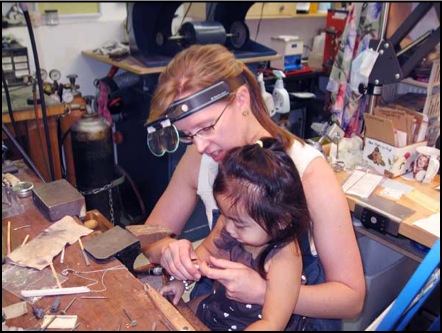
Properly
caring for your jewelry means Whitney, (and Alyvia), might
not see it at the workbench for big
repairs.
General jewelry care guidelines
Below
are some tips and solutions to jewelry care issues. Fine
jewelry is an investment that can last for generations with
proper care and upkeep. Should the unfortunate happen, we
recommend insuring your fine jewelry. Depending on your
policy, an arts and antiquities rider is sometimes
recommended. It is best to discuss this topic with your
agent.
We are happy to work with Jewelers Mutual Insurance, who
offer coverage to both businesses and individuals. Jewelers
Mutual was founded by jewelers in 1913 and remains the
leading insurer solely dedicated to insuring jewelry
and the jewelry industry. You can visit their website
at http://www.jewelersmutual.com
or stop
in to see us for more details.
Knowing
what to reasonably expect from your jewelry is key to
maintaining it properly. In many years as a jeweler I have
found that lots of otherwise rational people believe
jewelry is somehow exempt from the ravages of time and
wear. My theory is that it is easy to unconsciously confuse
the timeless sentiments and family bonds symbolized by a
piece of jewelry with the jewelry itself.
The truth is, all jewelry metals are relatively soft--even
platinum--and will scratch and eventually wear out. A ring
that is worn daily will need prongs rebuilt or replaced
every few years, and the shank (back) of the ring will
eventually become thin and need to be replaced. Any jewelry
with moving parts or places where two pieces of metal come
in contact (the links in chains come to mind) will wear
thin and eventually break. Surface finishes will wear down
and disappear completely in time. Stones will scratch and
chip, facet junctions will become worn; stones may fall
out, either because they shatter into pieces or their
settings give way. Even a diamond isn’t necessarily
“forever”--it, too, can chip and fracture.
Recommended jewelry maintenance includes regular
professional checkups to insure that stones are tight--a
loose stone will wear out its prongs from the inside--and
that the prongs have sufficient metal left to be secure.
This is especially important in these days of mass-produced
lightweight jewelry, when the life span of most commercial
jewelry can be counted in years, not decades. Most jewelers
will gladly oblige you with a free “clean and check”. Pearl
strands and bead necklaces should be restrung every couple
of years or whenever the silk begins to bag or fray.
Cleaning
your jewelry
Gems and jewelry always look their best when they are
clean. There are many metal cleaners, tarnish removers and
polishes on the market; most of these are fine for metals
but may damage or discolor certain gems. A rouge cloth, a
soft cloth impregnated with red diatomaceous earth (also
known as jewelers’ rouge), available at most hardware
stores, is good for removing fine scratches and tarnish
from metal surfaces. Buy one for each type of metal you
want to polish--silver, gold, platinum--and keep them
separate. Toothpaste is NOT a good metal polish and may
damage certain gems. Ultrasonic cleaners are fine for plain
gold jewelry, especially chains, but they can fracture
opals, pearls, emeralds, or in fact any gem with open
inclusions, and most ultrasonic cleaning solutions are not
suitable for organic gems and certain precious stones like
turquoise and malachite.
When wearing jewelry, apply common sense liberally: don’t
sleep with your jewelry on, especially chains. Water will
make rings slip off, so leave rings at home when you’re
enjoying water sports. I can’t count the number of sad
tales I’ve heard about vain attempts to retrieve a beloved
wedding ring from the lake. Remove hand jewelry before
gardening, housecleaning, or any work where your jewelry
may come in contact with hard or rough surfaces. You’d be
surprised how much damage can be done by a steel filing
cabinet or a car door. And if you have to remove an earring
or ring (or any other jewelry, for that matter) when you’re
out and about, don’t put it in a coin purse or in a pocket
with coin or keys.
Two chemical hazards to jewelry are bleach and mercury. A
quick dip in bleach to kill germs, followed by a good rinse
in water, is no problem for most jewelry. (Malachite,
turquoise and organic gems like pearl and coral are the
exception and should not be dipped in ANY chemical
cleaner.) But if gold jewelry is soaked in bleach for any
period of time, the alloy metals start to dissolve. This
damage is subtle but can result in cracks appearing if the
metal is stressed.
Mercury, the liquid metal in many thermometers, will bond
with gold to form a poisonous amalgam that can’t be
removed. If you get mercury on a ring, take it to a jeweler
immediately. The affected area can sometimes be ground off
or cut out and replaced if the mercury hasn’t migrated too
far up the ring shank.
Storing
your jewelry
Store your jewelry in separate containers or compartments,
not mixed together, because harder gems will scratch softer
ones and almost all gems will scratch gold or silver.
Pearls and beads should be stored flat so the thread
doesn’t stretch out.
Don’t store jewelry in plastic bags. Some plastics emit
vapors that can pit and discolor metal and corrode the
surface of pearls and certain other gems.
Opals, amber, and pearls and other organic gems should not
be put in long-term storage in a safe deposit box, because
the dry air there can cause them to crack or craze.
Opals should not be stored at freezing temperatures because
they may craze. Opals should not be subjected to rapid
changes in temperature.
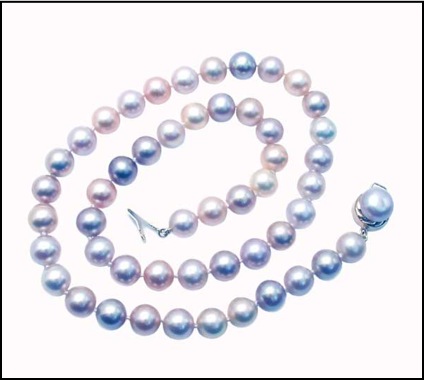
PEARL CARE
(The following
care advice pertains to all types of pearls, coral and
mother-of-pearl (shell) material).
Because they are an organic gem comprised of calcium
carbonate, pearls require more specialized care than most
other gems materials. They are particularly subject
to deterioration from contact with chemicals, including
components in household cleaners, perfumes, cosmetics and
hair care products of all kinds.
The surface of a pearl is soft and is easily damaged.
Pearls set in rings and bracelets are more subject to
scuffing and scratching than pearls set in brooches,
earrings, necklaces or strands. A pearl ring or
bracelet should be considered a special-occasion piece, not
for daily wear and DEFINITELY not to be worn while working
with the hands.
A good rule of thumb is that pearls are THE LAST THING YOU
PUT ON when dressing and THE FIRST THING YOU TAKE OFF when
you get home. NEVER apply perfume or hairspray when
you are wearing pearl jewelry, especially a strand of
pearls.
PEARL
STORAGE
Pearl strands
should be stored separately from other jewelry because the
surface of a pearl is soft and easily scratched by other
gems. A silk bag, velvet-lined box or pearl folder--a
satin-lined leatherette envelope with snaps to hold a
strand in place--are all good places to store pearls.
Your local jeweler is a good source for these items.
Never store pearls in a plastic bag. Some types of
plastic emit a chemical that will cause the surface of your
pearls to deteriorate.
Don't store pearls in a safe or safety deposit box for long
periods. The same ultra-dry atmospheric conditions
that extend the life of paper documents may dry out your
pearls and cause them to craze--to develop small fractures
in the surface.
Pearl strands should be stored flat rather than hanging so
the thread won't stretch out prematurely.
STRINGING
PEARLS
Pearl strands
should be restrung every one to two years or more often if
the thread begins to bag or fray. Silk and nylon beading
threads are the most commonly used materials for stringing
pearls.
Knotting between beads offers the most security for your
pearls; no matter where the strand breaks, you only stand
to lose a single bead. The look of the knotted strand
is not to everyone's taste, however. Whether you string
your pearls with or without knots, the first three or four
beads on either side nearest the clasp should be knotted
because this area takes the most stress and is the
commonest place for a strand to break.
PEARL CLEANING
It’s best to
have pearls professionally cleaned. If you must do it
yourself, here’s how:
Strands:
Lay the strand
flat on a clean soft cloth or towel. Make a mild
solution of soap flakes (I use Ivory soap flakes) and warm
water, and apply with a new pure natural bristle complexion
or manicure brush, scrubbing gently. Being careful to
support the strand so as not to stretch the thread, turn
the necklace over and repeat. To rinse, submerge the
strand in cool water flush with cool tap water for a
minimum of five minutes. Carefully remove the strand from
the water and lay it on a fresh towel to air dry. Don't
move it until it is completely dry.
Other pearl
jewelry:
The principle is
the same: use only a mild soap and a natural bristle brush,
then rinse with cool water for at least five minutes.
NEVER USE DETERGENTS, HOUSEHOLD CLEANERS, COMMERCIAL
JEWELRY CLEANERS OR TARNISH REMOVERS ON PEARL JEWELRY.
Never use your pearl cleaning brush for anything else, and
store it where it will not become dusty or soiled. Pearls
will naturally darken slightly with age and wear. The
golden or creamy tones that come with age cannot be
removed.
~Questions about
gems and jewelry may be addressed to gemologist Hanna
Cook-Wallace at Studio Jewelers, 1306 Regent Street,
Madison, WI 53715, telephone (608) 257-2627. You may
email her at: thegemologist@studiojewelerswi.com